Onryang-dong
O fenômeno Jungkook: O sucesso do BTS e a criação de um superstar mundialNonhyeon-dong is the formative Seoul setting of Jungkook’s trainee years and BTS’s earliest collective life. Around an unremarkable residential street in Gangnam, the neighborhood gathered the contradictory conditions that shaped the future star: distance from family, severe physical and emotional pressure, improvised comfort, and the intimate routines through which seven adolescents became a group. Its significance lies precisely in its ordinariness. Before Jungkook appeared in international hotels, stages, livestreams, and diplomatic settings, Nonhyeon-dong was the place where he learned to endure loneliness and belong to a found family.
Setting and Early Dormitory Life
Jungkook left his family home in Busan at thirteen and traveled two hours by KTX to Seoul, carrying his belongings through a narrow lane near Hakdong Park to an apartment on Nonhyeon-ro 149-gil. The building was not a luxurious training compound but an ordinary third-floor residence in Nonhyeon-dong, where RM, SUGA, J-Hope, and other Big Hit Entertainment trainees already lived. The dormitory was later described by J-Hope as a “rap nest,” a phrase that captures both its crowded informality and the project’s original identity as a group intended to center rappers and music producers.
The first arrangement was already a form of displacement. Jungkook had left the protections of home and shared a roughly 50-to-56-square-meter, two-bedroom dormitory with about nine other adolescents. When homesickness became overwhelming, he sometimes went to a nearby convenience store, ate instant ramen while crying for his mother, and bought a carton of banana milk after rehearsals as a small substitute for the home-cooked food he missed. The store was therefore more than a practical stop: it became one of the few places where a young trainee could seek private consolation inside an otherwise collective and regulated life.
A month before BTS’s debut, the company moved the finalized seven-member group to the building’s third floor. The apartment later associated with “I-sa (Moving On)” had cobalt-blue doors, a cobalt-blue bathroom, and a cobalt-blue balcony, earning the nickname “Blue House.” All seven members slept in one room on three bunk beds, while the youngest, Jungkook, slept on a single mattress on the floor. He was about 1.70 meters tall and still growing. With seven teenagers sharing one bathroom, his shyness shaped even the most basic routines: he waited until everyone else was asleep before bathing. Jin, the oldest member, drove the boys in his Mini Cooper and dropped Jungkook at Shingu Middle School, ten minutes from the Han River.
Refuge, Memory, and Group Formation
The neighborhood’s geography offered small interruptions to the relentless trainee schedule. The convenience store, the swings at Hakdong Park, and the bicycle path along the Han River gave BTS spaces in which to recover from exhausting agendas. These were not escapes from labor so much as brief pockets of ordinary adolescence. The boys could move through them as friends and brothers rather than as a future public institution whose every performance would eventually be scrutinized.
Nonhyeon-dong also preserved the group’s transition in material form. BTS had initially planned to debut as a hip-hop group, but Jungkook’s arrival contributed to a shift toward an idol group that rapped, sang, and danced. The cramped apartment thus housed not only trainees but a change in artistic strategy. As the company redefined the group, the burden of proving its musical range fell on the vocal line—Jin, Jimin, V, and Jungkook—with Jungkook, despite being the youngest, assigned the role of main vocalist and the most demanding vocal parts.
The apartment was later immortalized in “I-sa (Moving On),” released in 2015 on The Most Beautiful Moment in Life Pt.1. That retrospective connection turns Nonhyeon-dong into a chronotope of beginnings: the place appears simultaneously as a physical address, a remembered home, and evidence of the distance traveled since debut. Its blue doors and shared floor space stand in sharp contrast to the polished stages and global venues that would follow, making later success legible as a transformation rather than an unexplained arrival.
The First Public Jungkook
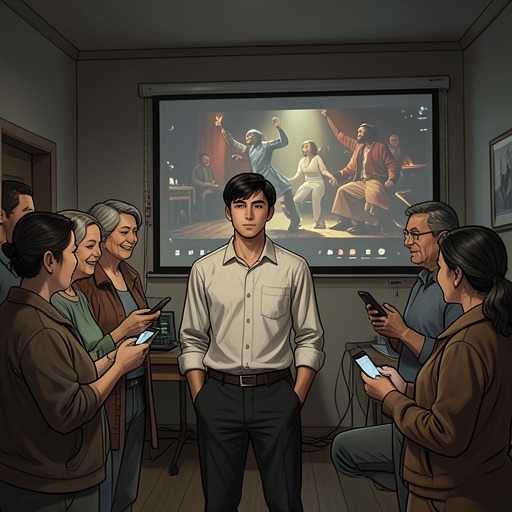
On February 8, 2013, four months before debut, Jungkook recorded his first Bangtan Log in the dormitory environment. At fifteen, he leaned toward a camera placed in the corner of a table and introduced himself to fans in his first close, personal public appearance. The scene is modest in scale but decisive in retrospect: the adolescent trainee speaking into a domestic camera would, over the next decade, become an international pop star.
The same early period reveals how the dormitory’s private intimacy coexisted with the first signs of public attention. On the day of his middle-school graduation, Jungkook wore a white dress shirt, a narrow tie, a wool coat, and side-parted black hair. A small number of photographers from early BTS fansites attended because they were intrigued by the group’s pre-debut media presence. Jungkook smiled while holding his diploma in a transparent folder and carrying bouquets of chrysanthemums. His parents were absent, but Jin, SUGA, and Jimin came instead, posing proudly with the youngest member. Nonhyeon-dong’s social world had already begun to substitute group kinship for the family life Jungkook had left behind.
From Dormitory Privacy to Public Performance
The contrast between Nonhyeon-dong and Jungkook’s later public spaces clarifies how his identity was built across thresholds. In 2017, when BTS occupied the tenth floor of the JW Marriott in Los Angeles after performing at the American Music Awards, Jungkook entered a photo-session room unexpectedly, wide-eyed and momentarily startled. He later sang quietly to himself in the makeup chair, smiled despite jet lag, and remained respectful toward the older members, who adjusted the collar of his denim shirt. During the chorus dance for “DNA,” however, he moved to the front, humming the melody and captivating a film crew unfamiliar with K-pop. The hotel scene shows the mature performer emerging from the shy, deferential boy associated with the dormitory, without erasing that earlier reserve.
The same tension persists in Jungkook’s livestreams. As the members began living independently, he started breaking the old practice of having staff supervise broadcasts, going live whenever he wished. During the COVID-19 period, his Weverse broadcasts became a source of pleasure for many ARMY members isolated at home. In June 2023, he even fell asleep during a broadcast watched by more than six million viewers, who observed him sleep for roughly forty-five minutes before a staff member ended the stream remotely. The episode reverses the usual direction of celebrity performance: a private, unguarded domestic moment becomes a mass event, echoing the way the old dormitory’s ordinary routines were transformed into collective memory.
The movement away from Nonhyeon-dong culminated in spaces of global recognition. At his first solo showcase in Korea, Jungkook performed twelve songs for 2,800 fans at Jangchung Arena after an eight-month solo campaign that had taken him to Good Morning America, The Tonight Show, collaborations with Usher, the Thames in London, and Times Square in New York. The international scale did not cancel the earlier geography. On the day before his surprise Times Square concert, he visited a Barnes & Noble carrying an iced coffee and looked with genuine astonishment at a display of Golden. Even after his achievements, he seemed connected to the same ordinary, questioning self formed in the neighborhood: someone still wondering whether he would buy another artist’s album to show support if he were not a singer.
Narrative Significance
Nonhyeon-dong represents the backstage of Jungkook’s public identity: the cramped, shared, and emotionally exposed space behind the polished image. It contains the objects and routines that make celebrity formation concrete—instant ramen, banana milk, a mattress on the floor, a shared bathroom, a Mini Cooper ride to school, and a blue-painted apartment. These details resist the idea that global stardom begins on a grand stage. In this setting, ambition is inseparable from homesickness, and group success is inseparable from dependence on older members who attend a graduation when the parents cannot.
The neighborhood also illuminates the larger structure of idol production. Trainees were housed together, disciplined together, and gradually reshaped according to the demands of the entertainment market. Yet the evidence presents Nonhyeon-dong as more than an institution’s training site. The convenience store, Hakdong Park, and the Han River path offered spaces of recovery; the apartment became a remembered home; and the members’ care for one another supplied a form of family within an industry built on surveillance, schedules, and managed appearances.
In that sense, Nonhyeon-dong is both a location and an origin story. It is where Jungkook’s separation from Busan became tangible, where BTS changed from a planned rap project into a multidimensional idol group, and where the future main vocalist first appeared to fans through a camera in a corner of the room. Later stages could magnify him, but they could not replace the neighborhood’s defining function: it was the ordinary place that made the extraordinary career imaginable.